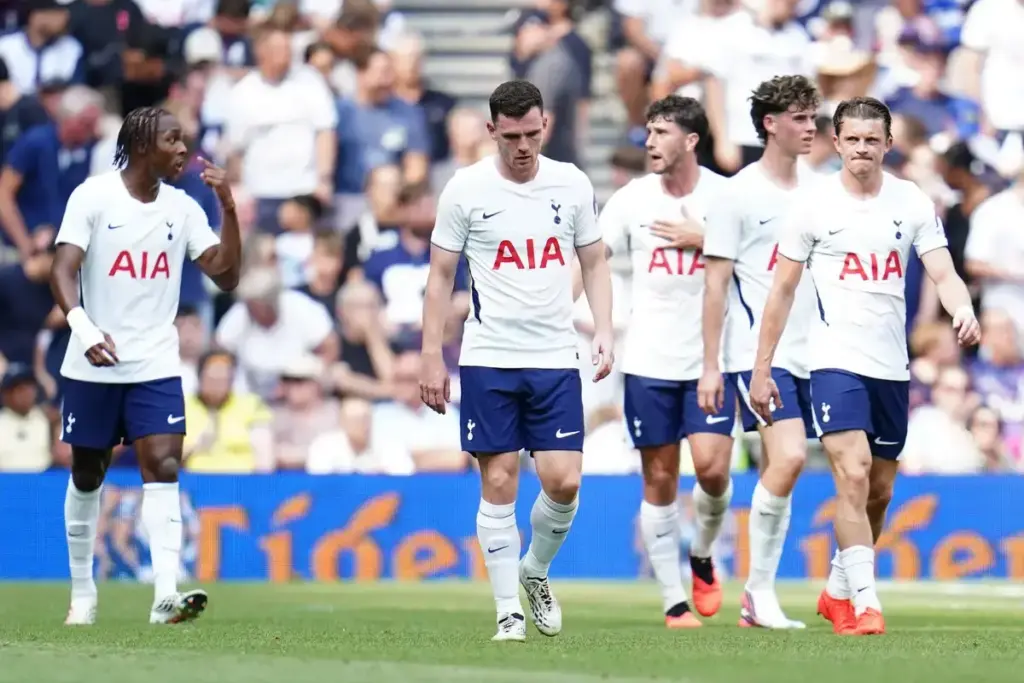

Tottenham won three home league matches last season. Three, from nineteen.
Ten defeats at the Tottenham Hotspur Stadium. Six draws. Twenty-two goals scored there across the entire campaign and thirty-one conceded, a home goal difference of minus nine.
Now the away record from the same season. Seven wins, five draws, seven defeats. Twenty-six scored and twenty-six conceded. Goal difference exactly level.
Read those two sets of numbers again, because they say something that sounds absurd. Spurs were a better football team away from home than at it, across a full Premier League season, in a stadium that cost over a billion pounds and holds more than sixty thousand people.
That is not a curiosity to be filed away with the rest of a difficult year. It is a genuine problem for anybody pricing a Tottenham fixture, because home advantage is one of the very few assumptions that goes into every single football price without anybody questioning it.
What home advantage actually is
Every model that prices a football match starts by giving the home side a bonus. It is not sentiment. It is one of the most durable findings in the sport.
Across the Premier League’s history, home teams win somewhere close to forty-five per cent of matches, and the adjustment applied to reflect that is usually worth around a third of a goal. It shows up in the win price, the handicap, the goal line, the corners and the cards. It is applied automatically to every fixture, before anything specific about the two teams gets considered.
The explanations are familiar. Crowd noise and its effect on decisions, particularly refereeing ones. Travel and disrupted routine for the visitors. Familiarity with the pitch and the surroundings. Whatever the precise mix, the effect is real and it is stable enough that no pricing model would dream of leaving it out.
Which is exactly why a club that reverses it causes trouble.
Spurs have inverted it two seasons running
This is not one strange campaign. The pattern has been building.
The season before last produced the strangest result in modern English football: a Europa League trophy lifted in Bilbao by a side that finished seventeenth in the Premier League and lost twenty-two of its thirty-eight matches, the worst record any team has ever survived with.
Then last season, seventeenth again. Ten wins, eleven draws, seventeen defeats, forty-one points, safe by two points above West Ham on the final day after João Palhinha’s goal beat Everton at home in May. And within that, the home and away split described above.
Two consecutive seasons in which the stadium has stopped functioning as an advantage. Three managers inside eight months while it happened, Thomas Frank sacked in February, Igor Tudor for forty-four days, Roberto De Zerbi from the end of March. And the pattern held through all of them, which is the detail that makes it interesting. Managers changed. The home problem did not.
The reason matters more than the number
It would be easy to write this off as anxiety, and there is clearly something in that. Ten home defeats does things to an atmosphere, and an expectant crowd in a stadium that expensive is not a forgiving environment when a match is goalless at half time.
But there is a footballing explanation underneath it that has far more use for anyone using crypto betting on Tottenham.
When Spurs play away, opponents attack them. Space appears, the game stretches, and this squad has always been better in a broken match than a controlled one. Twenty-six goals in nineteen away fixtures reflects that.
When Spurs play at home, visiting teams do the opposite. They sit deep, block the space between the lines and invite Tottenham to solve a problem that requires patience rather than pace. Twenty-two goals in nineteen home matches, against sides doing exactly that, is the result.
So the home difficulty is not really about the venue. It is about the kind of match the venue produces. That is a much more precise thing to know, and it converts into something actionable.
Where this shows up in prices
If a model is adding a standard home bonus to a club that has not earned one for two seasons, the errors land in predictable places.
Home win prices come out too short. That is the obvious one, and it means a Tottenham home favourite against a mid-table side arriving with a back five is usually a worse bet than the number implies.
The home draw is the market that suffers most. Six drawn home matches last season is a very high figure, and draws are exactly what happens when a possession-heavy side cannot break down a low block. Draw prices in Tottenham home fixtures have consistently been more generous than the actual pattern of results supports.
Away prices run long in the other direction. A club that took twenty-six points on the road while looking dysfunctional at home was, for much of last season, a better proposition away than the odds suggested.
And the goal markets split. Home matches produced fewer goals in a more controlled shape. Away matches were open and higher-scoring. Betting the same total in both is treating two different types of football as one.
The cup result that proves the point
Look at August for the clearest illustration available.
Two Premier League fixtures, no goals scored in either. Beaten 3-0 at Brentford on the opening day, then beaten 2-0 at home by Newcastle in front of 61,025.
Three days after the Brentford defeat, Charlton Athletic visited in the League Cup and were beaten 5-1 at the same stadium. Bergvall, Moore, Solanke, Danso and Sávio all scored.
The stadium was not the variable. The opposition’s approach was. Charlton had to come and play. Newcastle did not, and the difference was five goals.
Anyone judging the Liverpool tie at Anfield on 15 September should keep that distinction in mind, because an away trip to a side that will attack is precisely the fixture profile in which this Tottenham team has historically looked most like itself.
The honest caveats
Three things stop this being a straightforward instruction to lay Spurs at home every week.
First, nineteen home matches is a small sample. Real effects and random noise look identical over one season, and even two seasons of the same pattern is not the volume of evidence anybody would want before treating it as permanent.
Second, the market is not asleep. Traders read the same tables. By the second season of a pattern like this, some of it is already in the price, and the room for an easy edge shrinks accordingly.
Third, and most importantly, this is a different team. De Zerbi is starting his first full season with a squad that has been rebuilt and money that has been spent, and there is no European football this year to complicate the schedule. A manager whose sides typically dominate possession may find the low-block problem is the exact thing he was hired to solve. If he does, the numbers above become history rather than a guide.
Small edges need the right price
One practical consequence of all this. When the difference being exploited is modest, the price paid for it matters disproportionately.
A supporter who thinks a Tottenham home draw is undervalued is arguing about a fairly fine margin, and taking a worse number than necessary can erase the entire point of the bet. Prices on the same fixture differ between operators, sometimes noticeably on draws and alternative goal lines, which are exactly the markets this argument points towards.
For comparing how the crypto-friendly sportsbooks stack up on football coverage, pricing and terms, CryptoBets.com collects that in one place, which saves opening accounts to find out.
New customers registering with Stake Sports can apply NEWBONUS for a sports welcome bonus rising to a ceiling of $3,000, built up across betting activity rather than credited in one go.
Knowing something the model does not
The value in all of this is not a system. It is the recognition that a standard assumption applied to every football match in the world does not currently apply to this one club.
A supporter who has sat through three home wins in a season understands something specific: that the shape of a Tottenham home fixture depends almost entirely on whether the visitors are willing to come out, and that a deep-lying opponent turns the stadium into the hardest place this team plays rather than the easiest.
That is worth knowing before looking at a price. It is worth a small bet when the fixture fits. It is not worth a large one, because the squad has changed, the manager has changed, and the whole point of the last two seasons is that this club is capable of surprising everybody, including in a good way.
They did win the Europa League while finishing seventeenth, after all. Whatever else can be said about following Tottenham, nobody could accuse it of being predictable.

Comments.
Loading comments…